The Storykeepers
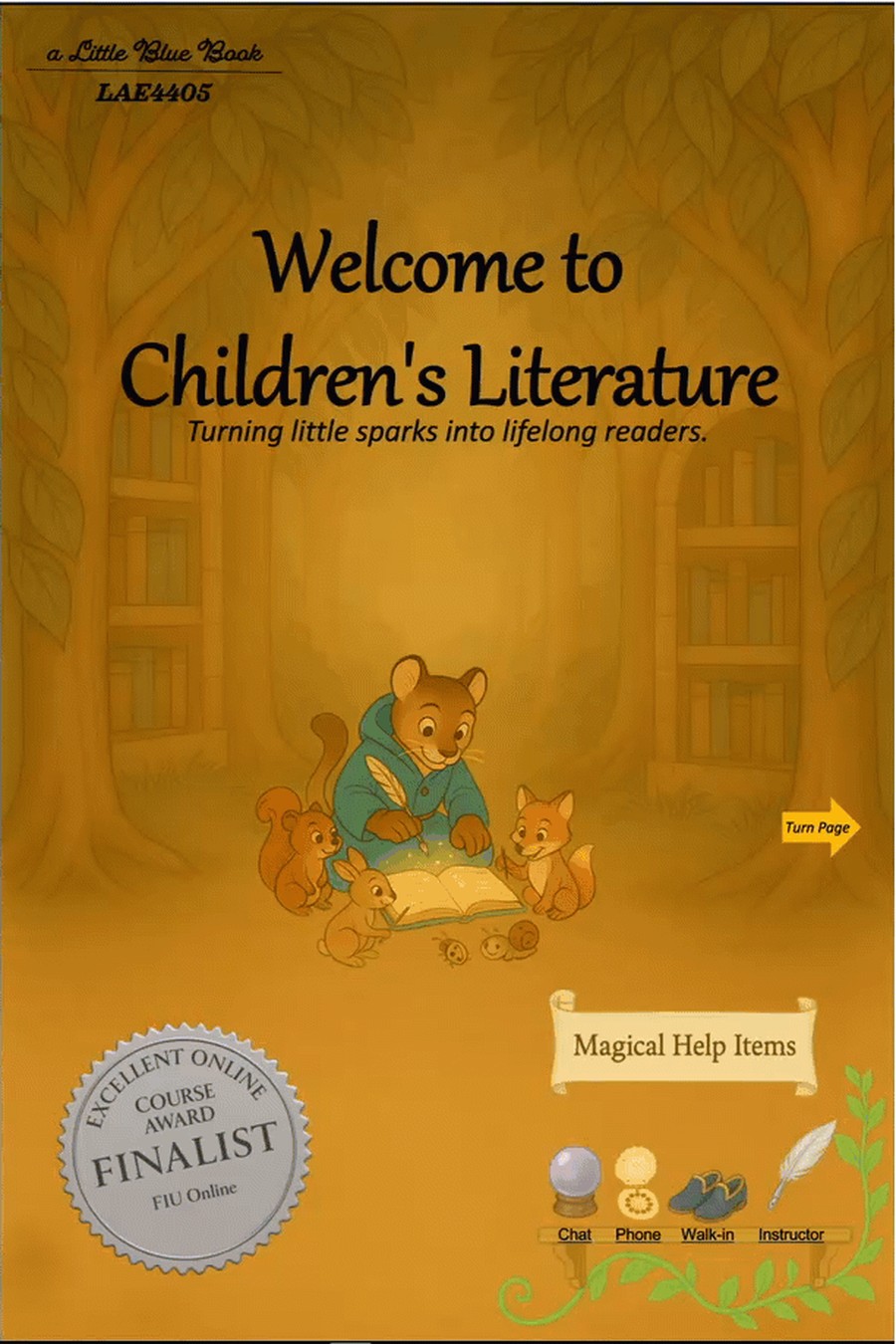
We were asked to redesign a children's literature course. So we turned the course itself into a children's book — gold foil on the spine and all.
The Brief
A course about magical books, delivered like a tax form.
LAE4405 is a children's literature course for future educators — the people who will one day sit cross-legged in front of a class and read Where the Wild Things Are well enough to make thirty kids hold their breath. The subject matter is some of the most enchanting, immersive storytelling ever made.
And like most online courses, it had historically been delivered as the least enchanting thing imaginable: a wall of text modules, PDFs to download, discussion boards to endure. There's a quiet irony there that bothered me from the first meeting. We were teaching people how to cast a spell using a medium that had forgotten the spell existed.
So my team and I asked a different question than "how do we explain children's literature more clearly?" We asked: what if the course didn't just teach children's literature — what if it was a children's book?
If you want future teachers to understand how a story pulls a child through a lesson, don't describe it to them. Put them inside one and let it pull.
The Insight
The students are the future authors of the thing we're building.
Here's what made this course special to design. The learners aren't just any audience — they're going to grow up to be the storytellers. They'll write the lesson plans, choose the read-alouds, and decide whether a generation of kids finds books magical or tedious. The single most valuable thing we could do for them wasn't to lecture about narrative immersion. It was to let them feel it from the inside, as the audience, before they ever had to perform it for someone else.
That's a pedagogical principle older than online learning: people learn powerfully by experiencing a thing modeled well. So we'd model it. The whole course would be written in second-person point of view — the way a children's book talks directly to "you" — and the student would be the hero of it.
The Design
Welcome to Whimwood Library.
You arrive for your first day as a Storykeeper at Whimwood Library alongside Ellie — a talking golden panther, because of course the guide had to be FIU's own mascot. The two of you are new here together. And something is wrong: the magic of the library is fading. Books are going blank. Words and pictures are vanishing off the shelves. When Ellie opens the Book of Origins — the tome that's supposed to hold every Storykeeper's story — its pages are empty too.
From the course · Module 1 · The Welcome Wing
"Oh no," Ellie says. "These pages are blank! Where did all the stories go? Where is my story? Where is yours?"
She stands firm, and retrieves her magical quill from her backpack. "We are Storykeepers. That means there is a story in our hearts. So if there is no story in the Book of Origins for us, then we'll have to write our own!"
That moment isn't decoration — it's the on-ramp to the actual coursework. Ellie's call to "write our own" leads straight into the first discussion board, which we renamed from "Introduce Yourself" to "What's Your Origin Story?" The student's required intro post is now the opening page of their own story. Same learning objective. Completely different reason to show up.
From there, every module is a chapter. The structure that's usually invisible administrative scaffolding — module overviews, learning materials, assignments — became the bones of the story without us inventing a single new task:
The narrative goal and the learning goal are never in tension because they're the same goal. Helping the library and passing the course are one act.
A chapter, up close
The fox who only wanted to know why flowers are pretty.
Take Module 5, in the Development Den. You and Ellie find a young fox hunched over a book miles above his reading level, getting more frustrated by the second. When Ellie asks what's wrong, he says he just wants to know why flowers are so pretty — and the book he grabbed isn't built to tell a reader like him.
It's a charming scene. It's also a precise setup for the module's real content. The Keeper Scrolls here are chapter readings on children's language and cognitive development, articles on differentiated reading instruction, and a guide to writing a children's-book lesson plan. The fox isn't a mascot — he's a case. By the time you've read the scrolls to help him, you've absorbed exactly the developmental framework the module is meant to teach.
Then comes the assignment, and it's no toy: the student designs a comprehensive reading program for a fictional child profile. The story earns the rigor. You don't get the cute fox without doing the real instructional-design work — and you want to do it, because by now you've met him.
What happened
The professor's reaction told us we'd nailed the hardest part.
The risk with a redesign this ambitious is always the same: that the spectacle eats the substance, that you build something delightful that no longer teaches what the professor needs it to teach. The clearest signal that we avoided that trap came from Laura herself — the subject-matter expert whose learning objectives were on the line.
"Overall, I LOVE the story. It is so clever: it's a story, it's a quest, and it's the module overviews. I cannot compliment you enough for how amazing this is!"
— Prof. Laura Monsalvatge, course instructorWhat I value most in that note is the phrase "it's the module overviews." Laura saw exactly what we were going for: the story wasn't sitting on top of the course as a coat of paint. It was the course's structure. And critically, she confirmed the part that actually matters — that her students were still learning everything she needed them to know, fully immersed in a story that feels like the ones they'll someday read to their own classrooms.
The course has since been recognized as a finalist for FIU Online's Excellent Online Course Award — outside validation, on top of Laura's, that the storytelling never came at the expense of the teaching.
That last part is the quiet triumph of the whole project. The course doesn't just teach future teachers about immersive storytelling. It hands them a finished example of it, addressed to them, that they got to live inside for sixteen weeks.
Why it works
The design decisions, and the theory under them.
This wasn't decoration applied to a course — it was a set of deliberate pedagogical bets, each grounded in something real. Narrative transportation: a reader absorbed in a story lowers their defenses and takes on its ideas more readily than one being lectured, so we gave students a world worth being absorbed in. Constructivism: people retain what they build, not what they're told, so every chapter ends with the student making something — a reading program, a lesson plan — to solve a problem they care about. Second-person immersion: casting the learner as the protagonist turns a passive "complete the module" into an active "help the library," which is the difference between an audience and a participant.
And the bet I'm proudest of is the meta one. Modeling is one of the most durable mechanisms in all of learning — we absorb how to do things by experiencing them done well. This course models, for sixteen weeks, the exact craft its students are training to practice: direct address, narrative immersion, meeting a reader where they are. The medium is the lesson. That's not a flourish I can take full credit for inventing — it's the oldest trick children's authors have — but applying it to the architecture of a university course is where the work was.
The bigger idea
What this has to do with content strategy.
Strip away the panther and the library and what's left is a discipline marketers spend careers trying to master: building a world an audience wants to live inside, and making the thing you need them to do feel like a natural move within it. Whimwood Library is a brand world. Ellie is a brand character. The Storykeeper identity is the thing the audience gets to become — and the coursework is what they do because they've become it. That's the architecture behind every brand universe that actually commands loyalty rather than renting attention.
It's also a clinic in two specific content-strategy muscles. The first is second-person address — the best brand copy, like the best children's books, casts the reader as the hero and speaks straight to them. The second is the idea that structure is content, not packaging. The most repeated lesson of this project is that we didn't bolt a story onto a course; we discovered the course already had a structure, and we gave that structure a story to mean something. Good content strategy works the same way: the format, the sequence, the journey aren't the wrapper around the message — they are the message.
A children's literature course taught me, of all things, how to make people care about something they showed up indifferent to. Which is, more or less, the entire job.