NDIC, On Stage
A framework isn't real until it survives a room. So I took mine to conference stages across the country — and refused to give a boring talk about not being boring.
The idea
Building the framework was only half of it.
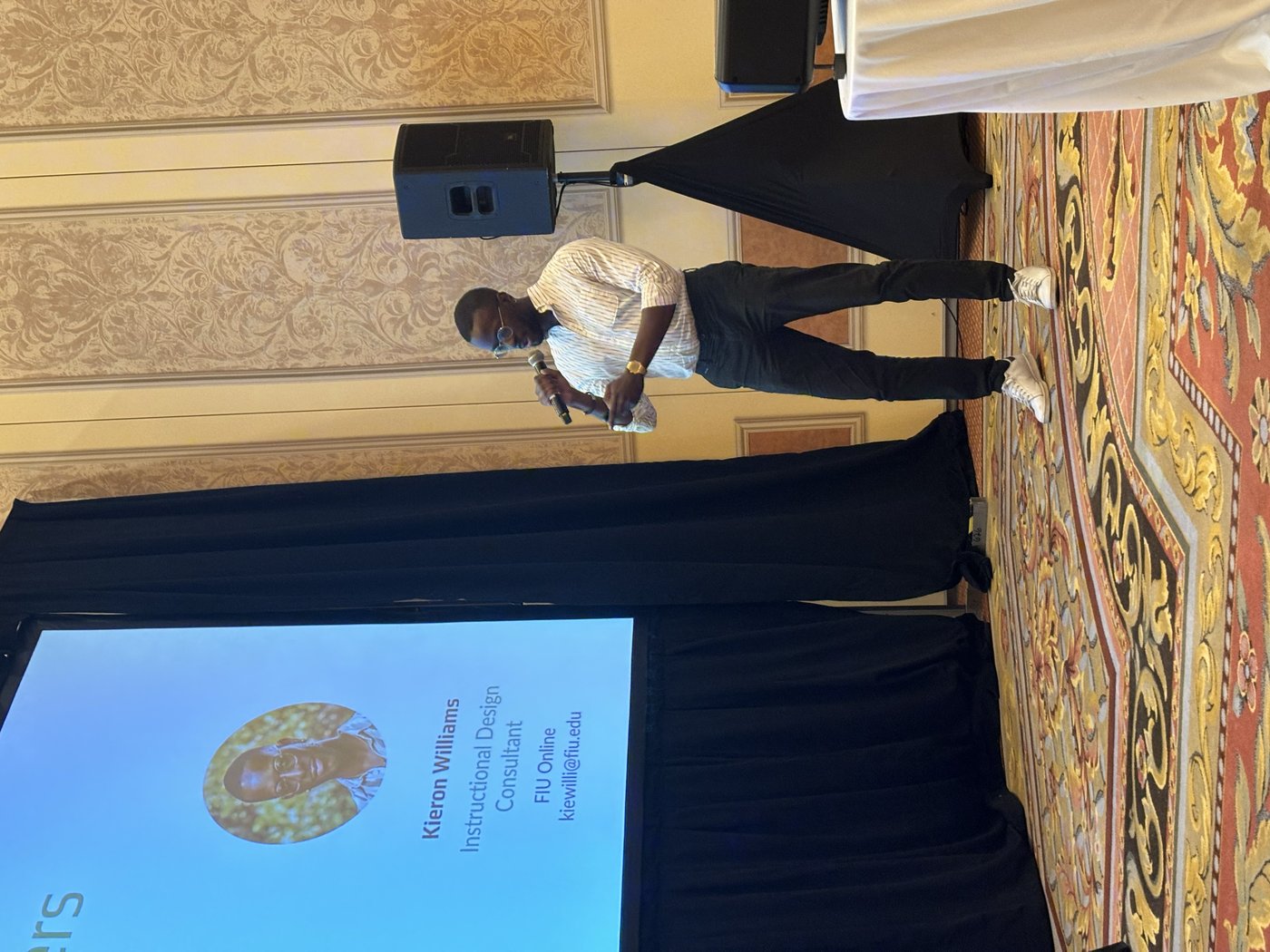
Everywhere else in this portfolio, I'm building things. This one is about the other half of the job: having a point of view worth putting on a stage, and being able to hold a room while you make the case for it. I developed Narrative-Driven Immersive Constructivism — NDIC — as a design philosophy, but a philosophy nobody's heard argued is just a private opinion. Between 2023 and 2024, I took it, and the arguments around it, to conferences across the country.
And I gave myself one rule: I would not stand up and lecture a room about engagement. That would be a betrayal of the entire premise. If my whole thesis is that you teach by pulling people into an experience rather than talking at them, then my talks had to do the thing they were arguing for. Both of the ones below did — in two completely different ways.
If your argument is that lecturing doesn't work, the one thing you're not allowed to do is prove it by lecturing.
Talk one
The talk about play that turned the room into players.
This was the talk that introduced NDIC as something every professor and instructional designer in the room could use tomorrow. It opens on three claims: that storytelling is the original pedagogy; that a fully online classroom can't be measured with in-person metrics; and that story-as-pedagogy is what fuses those two problems into one usable method. From there we walk through the mess in Maikel's course that led us to build Lost in the Pantherverse, the ways human beings are neurologically wired for narrative (drawing on Kendall Haven's TEDxStanford talk, "Your Brain on Story"), and the universal components of a story that actually grips people.
Then the provocation that reframes the whole room: your students are being out-competed for attention right now by stories more compelling than the ones their courses are telling. Which sets up the definition:
NDIC, defined
"Any method or practice of teaching where students are given a role within a story-driven narrative and must then learn to apply the course content to make progress, overcome obstacles, and ultimately influence the trajectory and the outcome of the narrative."
And then, instead of ending on a slide about how play drives engagement, we did it to them. Near the finish, we pretended our presentation had hit a "bug." To fix it, the audience had to get up, search the actual room for hidden QR codes, scan them, and answer trivia from the talk to assemble the code that would "repair" the slides. A room full of conference-weary professionals spent the last stretch of an ed-tech session hunting for QR codes and laughing. The talk about engagement-through-play became an act of engagement-through-play — Aaron and I had built the scavenger hunt, and here it was, running on the audience.
We were told afterward it was one of the audience favorites of the entire event. The point had made itself, because the room had lived it.
▸ View the deckTalk two
The AI talk that was an argument you could watch happen.
When ChatGPT landed and higher ed spent the next couple of years fearmongering about it, Maikel and I kept having the same debate in our office — him the optimist, me the skeptic. So we put the debate on stage, more or less verbatim. He played the futurist, I played the humanist, and the audience watched us argue it out in real time rather than sit through a tidy, pre-resolved set of bullet points about "AI in the classroom."
The format was the argument. Instead of asserting that the right answer is human judgment working alongside the tool, we modeled that reasoning live — two people thinking in public, disagreeing in good faith, and landing where we actually landed: that AI amplifies the best of us, our imagination and wit and industry, but only for the people who refuse to outsource the very thinking that makes them worth amplifying in the first place. You can't hand someone that conclusion on a slide. You can let them watch two colleagues reach it.
It worked well enough to become a franchise. The sequel, "You're the Problem, Not ChatGPT," ran at InstructureCon in 2024 — same back-and-forth format, this time with a moderator in the middle: Sean Nufer, another AI-in-higher-ed voice we'd met on the circuit. A talk becoming a series is the clearest signal I know that the argument was landing.
▸ View the deckThe through-line
Both talks practiced what they preached.
Look at the two side by side and the pattern is the whole point. One argued that engagement comes from play, then made the room play. The other argued that good thinking about AI is a live, human, dialectical act, then staged it as a live human dialogue. Neither talk described its thesis. Each one performed it — which is precisely the NDIC claim, turned on the audience instead of on students.
That's the version of "thought leadership" I actually believe in. Not having takes, but building the take into the delivery so completely that the audience doesn't just hear the argument — they experience it, and remember it because they were inside it.
The record
Where this has been on stage.
I've presented NDIC — or work powered by it — at conferences across higher education and ed tech:
The bigger idea
A named framework and a POV is brand-building.
Content strategy runs on point of view. Not information — anyone can produce information — but a distinctive angle, named and delivered so memorably that people repeat it and come back for more. That's what NDIC is: I didn't just do engaging work, I gave the underlying idea a name, an argument, and a stage presence, and I got rooms of skeptical professionals to buy in and invite the follow-up. Building an idea into a recognizable position and platforming it is the exact muscle behind brand voice and thought-leadership content.
And the ChatGPT talks aren't a tangent from the pivot — they're on the nose. They're content about the precise tension every content and creative team is negotiating right now: how AI and human craft coexist without one hollowing out the other. Having a considered, tested, publicly-argued position on that isn't a nice-to-have for a content strategist in 2026; it's close to the job.
The instinct underneath all of it is the one I'd carry into any content role: don't describe the value, deliver it in the form itself. Make the medium the message. It's what made these talks land, and it's what makes content worth remembering.