Mission: Zorbitron
The department needed a game for 200 people who'd never rolled a die. We had two weeks. So we abducted them to another planet.
The Brief
Build a game for 200 strangers. Two weeks. Go.
In mid-April, the admin team went looking for the game-masters, designers, and activity leaders on staff and handed a few of us an unreasonable assignment. Their 200-person Spring team meeting needed a closer — a two-hour finale, the climax of the whole day, right before goodbyes. Camilo, Mike, and I got the call. We had two weeks to design it, a playtest in front of the admins two weeks out, and then one shot to run it live for the entire department.
The creative control was total; the constraints were the hard part. It had to be genuinely interactive, playable among people who didn't know each other, and it had to embody the meeting's stated theme, which I kept taped to the top of every planning doc: hands-on, fast-paced, and interactive — collaboration, creativity, adaptability, and problem-solving.
The subtext wasn't subtle. A department that spends its life preaching brainstorming and thinking outside the box now had to be that, on stage, in front of itself. This was the org putting its money where its mouth was — and we were the ones holding the money.
They didn't want a presentation about collaboration. They wanted two hours where 200 people had no choice but to do it.
Who built it
Three of us, one map, and a very short clock.
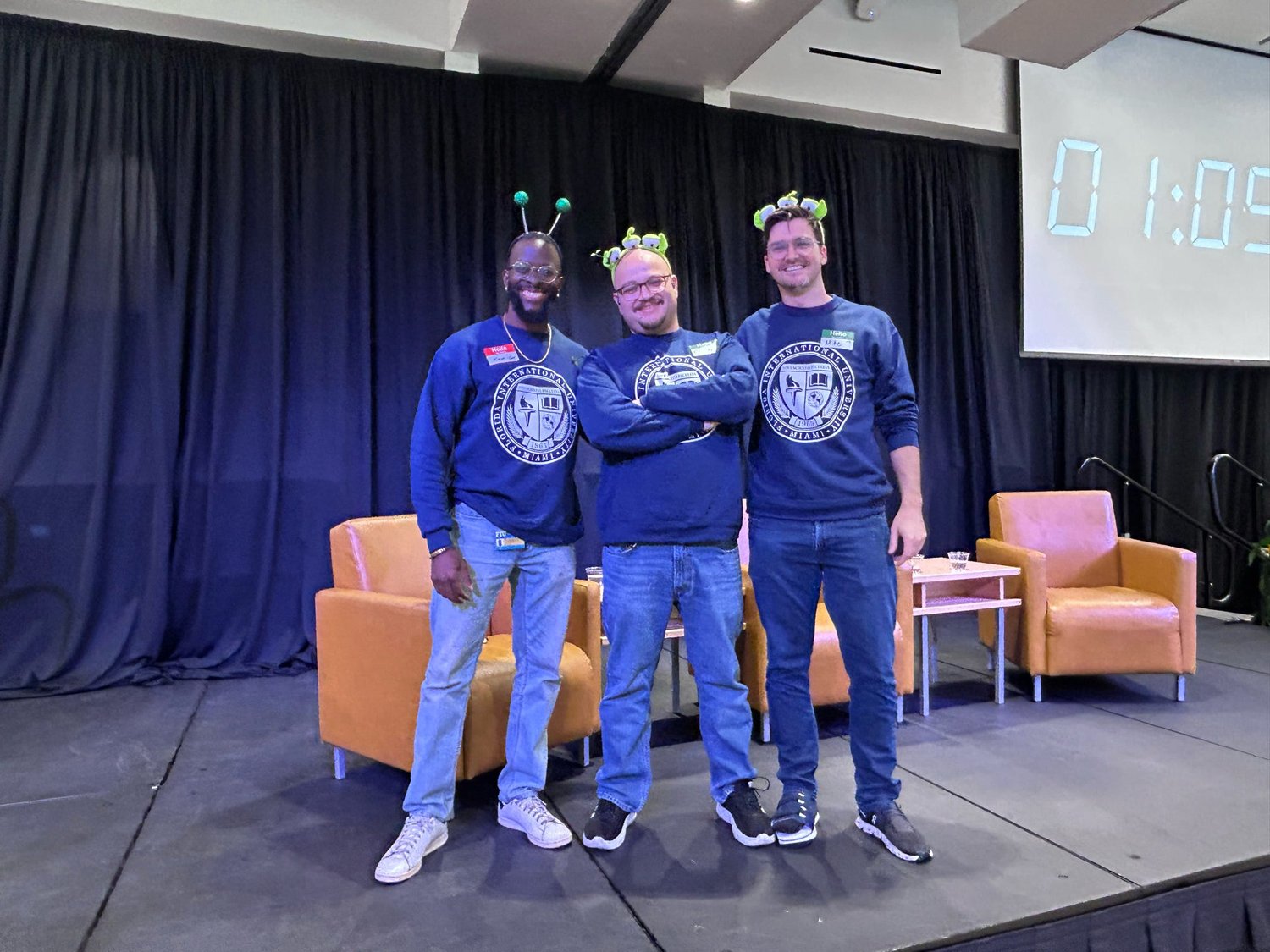
Honest credit up front: this was a three-person build, and it doesn't work without all three. Camilo and Mike drove much of the mechanical design — the math that made 20 tables resolve fairly and on time. I owned the narrative world and ran the game-master training program. All of us designed, playtested, and ran it together on the day.
The Insight
Give 200 people the moment that hooked me on D&D.
We started with a card game and killed it fast — it wasn't collaborative enough. I kept pushing toward a tabletop role-playing game, because I wanted to hand a room of professionals the exact moment that got me hooked on D&D: the spotlight swinging to you, the game-master asking "what do you do?", and suddenly you're thinking inside a character, inventing a solution out loud with no script. That feeling is engagement in its purest form. The trick was manufacturing it for 200 people, most of whom had never touched a d20.
The premise I landed on did the heavy lifting. Mike, Camilo, and I would be the leaders of the planet Zorbitron. We'd been watching Earth, fallen in love with higher education — and specifically with FIU — and built our own knockoff, Zorbitron University. It had gone catastrophically, because we didn't actually understand universities. So we abduct the FIU Online team (whooshes and sound effects fully committed to on the mic), bring them to Zorbitron, and beg them to look around and fix it. The catch: we have unlimited energy, labor, and resources. What we don't have is time. The new semester starts in two Earth hours.
The Design
Every table its own planet.
Each of the 20 tables sat up to ten players plus one volunteer Zorbitronian Representative — the game-master. In the middle sat a game board shaped like a plus sign, four hallways leading to four wings (Design, Comms, Tech, Ops), three Rooms each — and a 3D-printed alien the team "rode" as their vehicle, because, naturally, humans can't breathe on Zorbitron. Every player got a character sheet tied to their real FIU role, sorted into one of four classes:
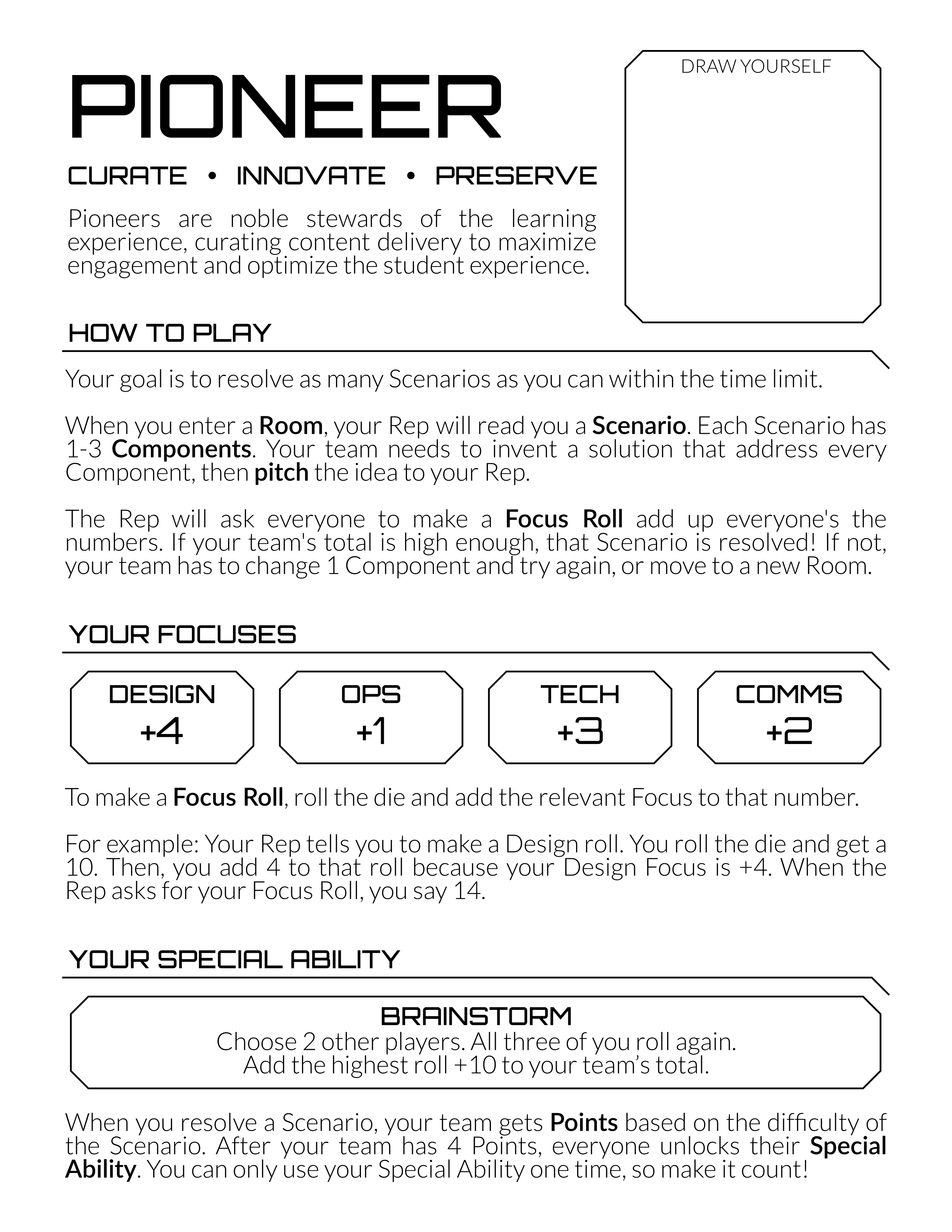
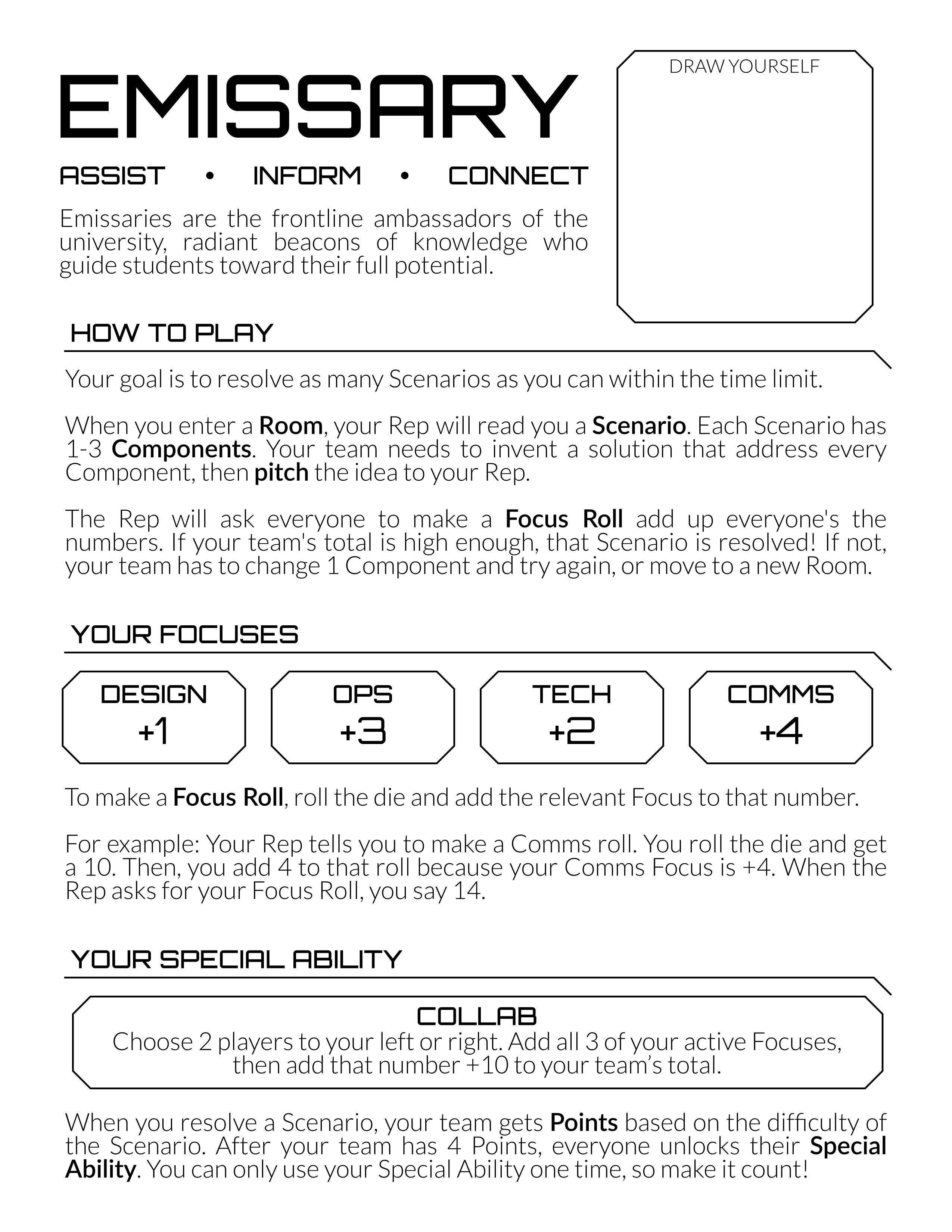
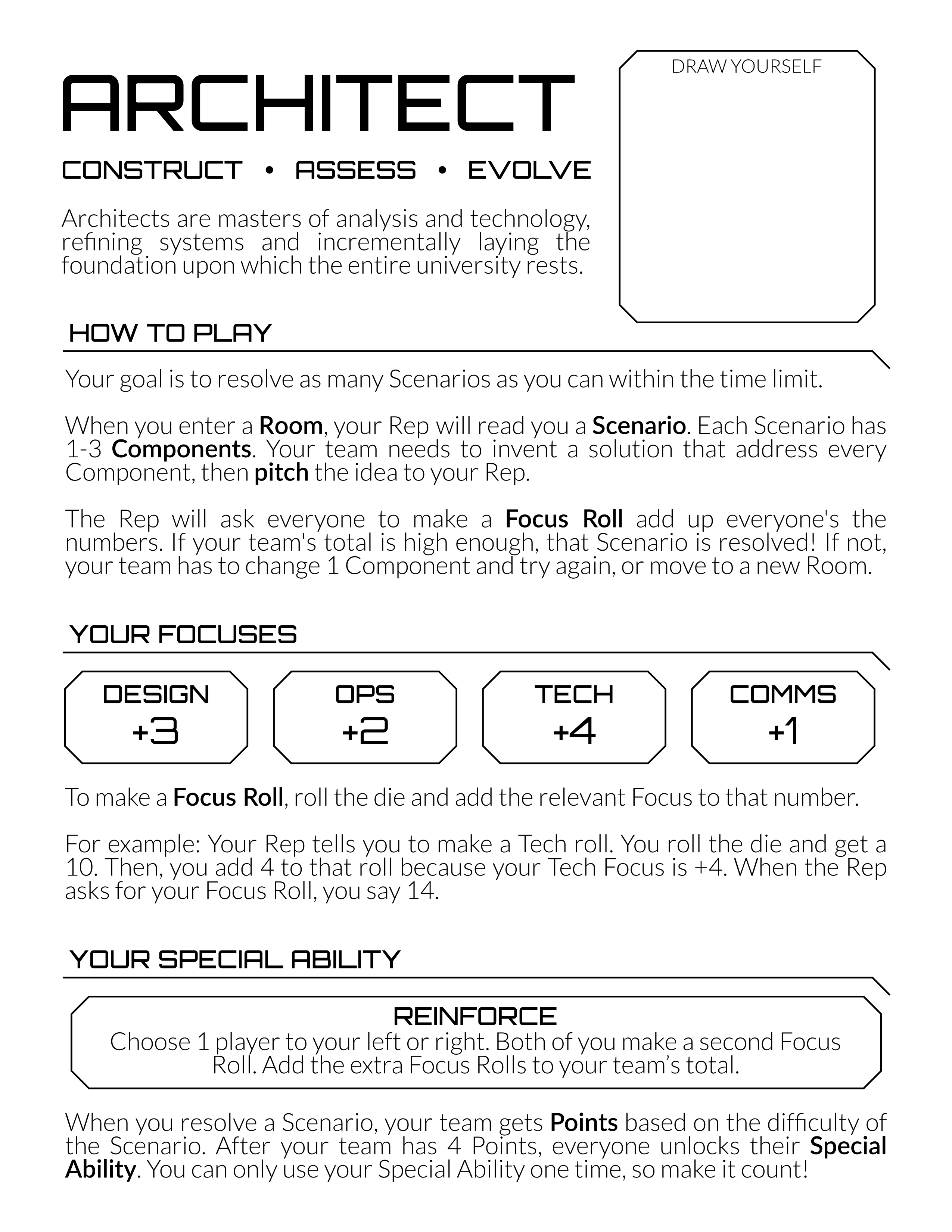
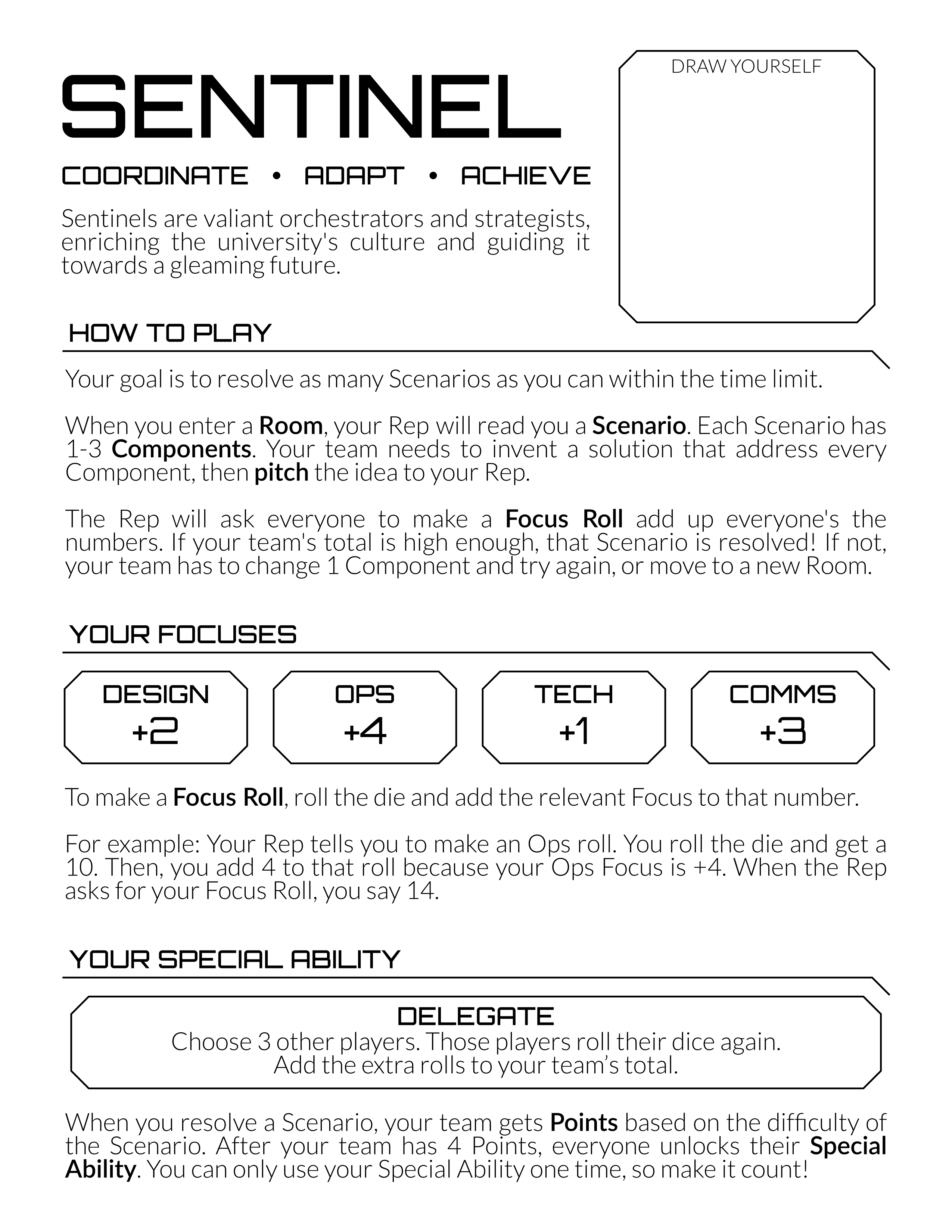
The four player classes, each with its own Focuses and a collaborative Special Ability. Tap any sheet to view it full-size.
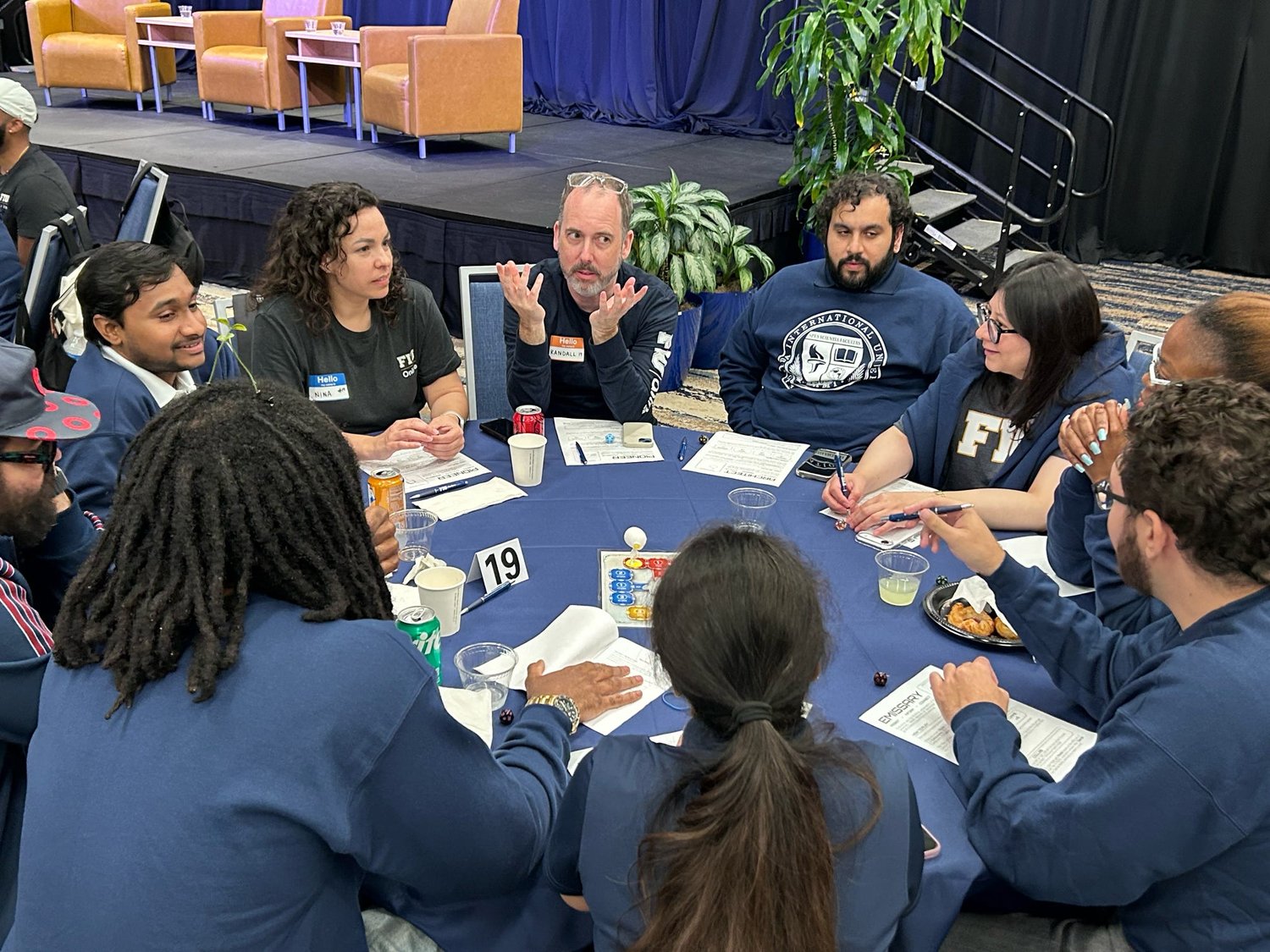
Here's the loop. The team enters a Room. The Rep reads a Scenario ending in one to three Components — the specific things any solution has to address. The team invents a fix together, and one player pitches it. Then everyone rolls a Focus Roll (a d20 plus the relevant Focus from their sheet), and the Rep sums the table against a Threshold scaled to the group's size. Clear it and the Scenario resolves; fall short and you swap out one Component and adapt. Points accrue, and at four Points the whole table unlocks their one-time Special Abilities — every one of which requires pulling in teammates.
"Hello, and welcome to Zorbitron! My name is [Rep name] and I'll be your Zorbitronian representative for the next two Earth hours. I am a HUGE fan of FIU and I am SO excited to see you all in action."
"If you look around, you'll see we're in the center courtyard of Zorbitron University. We have the Design Wing, the Comms Wing, the Tech Wing, and the Ops Wing. Two Earth hours really isn't a lot of time, so… where would you like to go first?"
The design decision I'm proudest of is who the Rep isn't. The game book instructs game-masters to know nothing: "You are a quiet, enthusiastic Zorbitronian who loves to help but has nothing to add." The alien can build anything in milliseconds and understands none of it. That single inversion makes the players the experts — their real jobs become their superpowers — and forces them to explain, teach, and collaborate their way to every answer. The brief asked for collaboration; we built a machine that physically can't run without it.
And the Scenarios smuggled real work inside the comedy. Each one is a genuine higher-ed problem wearing a clown suit:
"We saw that FIU has servers, so we built one. Just the one. It is the size of a small moon."
The real problemA single point of failure takes down the whole campus. How do you design a system where one faulty component doesn't break everything?
Players thought they were riffing on a silly alien. They were actually doing systems design, instructional design, and service planning — resilience, identity management, connectivity at scale, what real teaching looks like versus a 60-hour video of someone reading a textbook aloud. The learning was the byproduct of the bit. That's the whole thesis of how I design.
The scale problem
How do you run one game for 200 people at once?
The answer we're proudest of is that the story was the stage management. "Two Earth hours" wasn't just flavor — it was a literal two-hour countdown projected on the auditorium wall, which doubled as narrative pressure and as the metronome keeping 20 tables roughly in sync. The fiction did the logistics.
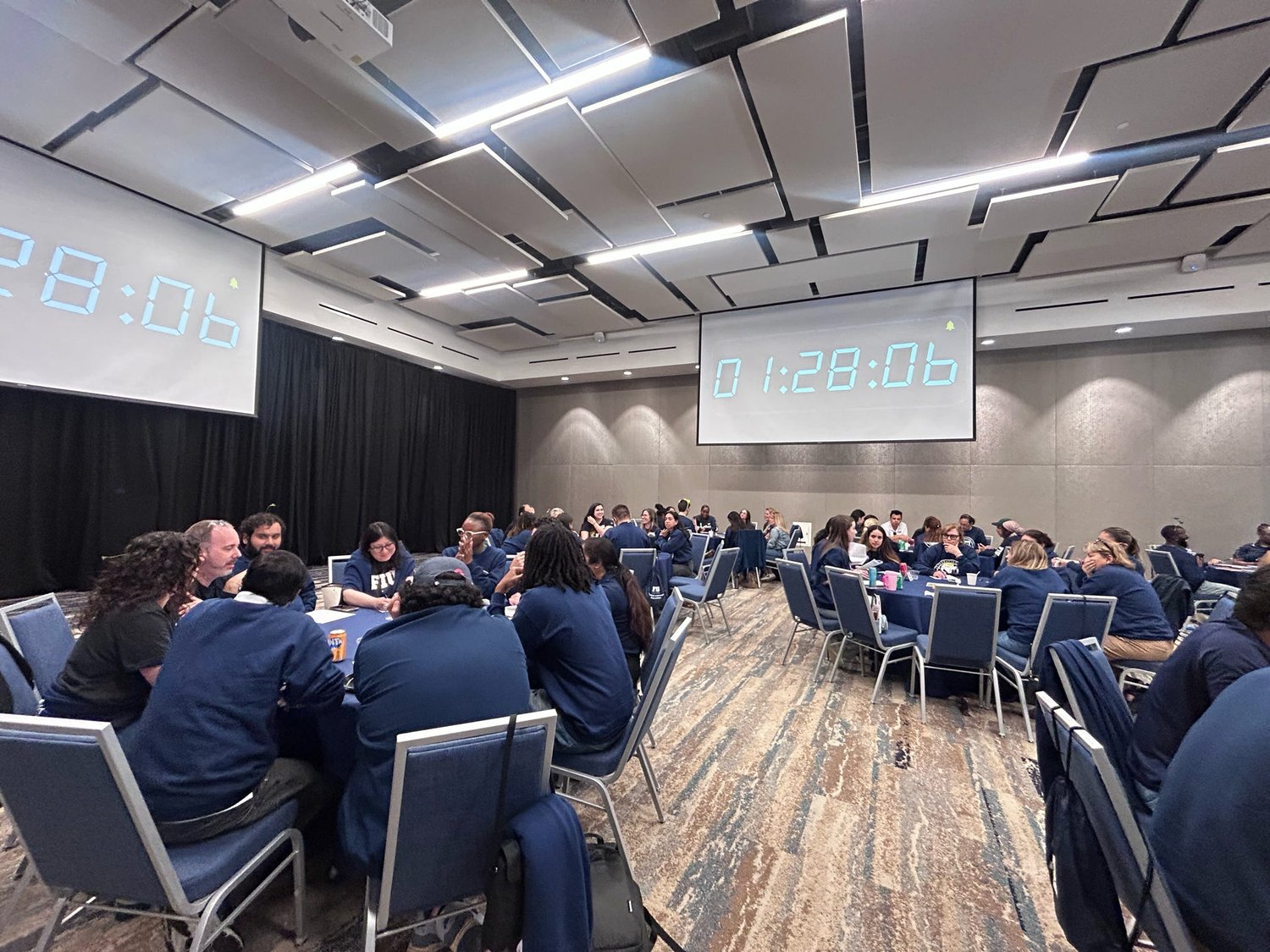
The game ran in three timed acts. In Act 1, tables cleared as many Rooms as they could. In Act 2, every completed Room grew a Complication — a fresh scenario demanding a different Focus, so the table had to lean on different members. In Act 3 we pulled the boards entirely: every table in the room faced the same boss, The Auditor, a four-Component mega-scenario resolved with a Super Roll of everyone's dice, all their Focuses, and every Point they'd banked. Each Rep reported their table's total into a shared Slack channel, where the three of us tallied the entire room's fate live.
None of that runs on three people. We recruited 20 volunteer game-masters from across the department — folks chasing a leadership rep, lapsed D&D players, or the plain curious — and I ran them through two full training sessions: explain the game, play the game, then answer every question until the nerves were gone. We stood up a dedicated game-master Slack channel so they could reach us with anything, right up to and during the live event. The trained, supported humans were the real infrastructure.
What I'd do differently
A game about adaptability that demanded a lot of it.
Here's the part I find funniest in hindsight: the meeting's theme was adaptability, and the day made us live the lesson. At this scale you don't rehearse your way to zero surprises — you build a team and a system loose enough to absorb them. Ours got tested hard:
A vanishing volunteer. One game-master left partway through the first training and never returned for the second. We caught it early but couldn't fully fix it until game day, when we paired a co-GM onto that table.
We were also GMs. We'd planned to be the MCs — running act transitions, roaming to help struggling tables. Last minute, we learned we'd also be running our own tables. So we juggled a live table, sprinting on stage to transition acts, and watching the Slack channel, all at once.
A language gap we didn't plan for. Mid-game we realized every table had at least one player who spoke no English — some as many as five. It genuinely affected those tables' experience. It was also something we could have designed for had we known — a straight lesson in doing the audience research first.
A hard last-minute call. A virtual table needed a strong player, so I pulled a confident D&D player off a GM team that was counting on him. It left them uneasy; I told them to call on us for anything, and had to accept that being enough.
We ran out of manuals. Physical game books ran short at the last second, so we dropped the file into the GM Slack channel and made sure everyone missing one knew where to find it.
We solved most of it in an impromptu game-master huddle in the corner of the auditorium, minutes before kickoff. That huddle — not any single plan — is what actually held the event together, and it only existed because we'd built the team and the channel to make it possible.
What happened
A standing ovation, and a hug from the head of the department.
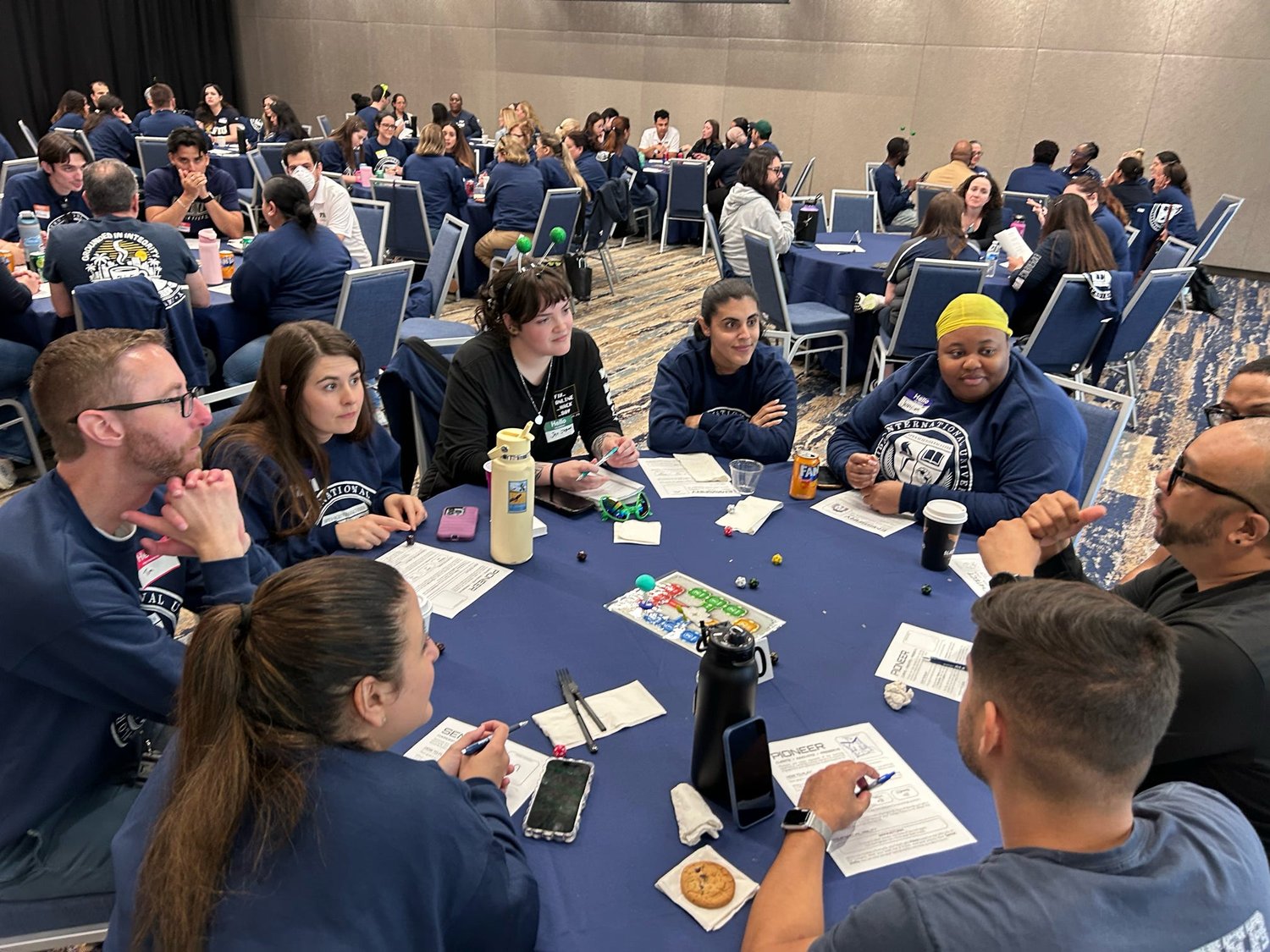
It landed. The whole FIU Online team gave the game a standing ovation. Volunteers and players came up to thank and congratulate us, and the praise kept coming on the way out the door. Lia — the Associate Vice President of Academic Affairs, and the head of FIU Online — gave me a hug. Emma, the event manager who'd dreamed up an "Agility Quest" for the meeting in the first place, gave us shout-outs from the front.
But the number I keep coming back to is 200. Roughly two hundred people, the overwhelming majority of whom had never played a tabletop role-playing game in their lives, spent two hours fully inside one — rolling dice, inhabiting a class, pitching increasingly unhinged solutions to a confused alien, and loving it. Getting a room of professionals to do that, and mean it, is the entire proof of concept.
The bigger idea
This is what shipping under pressure actually looks like.
The course designs in this portfolio prove I can build one immersive thing carefully. This one proves something a content or brand team needs even more: I can produce a novel, high-engagement experience under real-world pressure — a two-week deadline, a 200-person audience, an unfamiliar format, unknown constraints, and no second take — and improvise when the day fights back. That's not a school project. That's the campaign that has to land live, on the day, with the whole company watching.
Three things here transfer straight across. First, we didn't make content about a value — we built an experience that enacted it; the brief said "collaboration," so we engineered a machine that couldn't function without it, which is exactly how the best brand work makes you feel something instead of reading a claim. Second, we onboarded 200 skeptical strangers into an unfamiliar format in minutes — the core challenge of every new channel, product, or content type, solved by lowering the barrier and wrapping it in story. Third, we directed 20 people to deliver one consistent experience across 20 rooms — which is just scaled content operations and editorial consistency, run live with a Slack channel for a control room.
The brief was four words: collaboration, creativity, adaptability, problem-solving. We didn't put them on a slide. We built a two-hour machine that made 200 people embody all four — and then embodied them ourselves when the day tested us on the same list.